Monday, 31 December 2012

Who's the chicken?

From: DonkeyHotey

The world waits with bated breath for an outcome of the ongoing fiscal cliff talks in Washington with much the same anticipation that accompanied the end of the Mayan calendar on December 21. As it happened the end of the world was not to be, and sadly, a grand bargain on how to tackle America’s sickly finances may not grace the news headlines either. There will in all probability be a last minute deal, a fudge of sorts that merely postpones a long-term solution to America’s burgeoning debt.

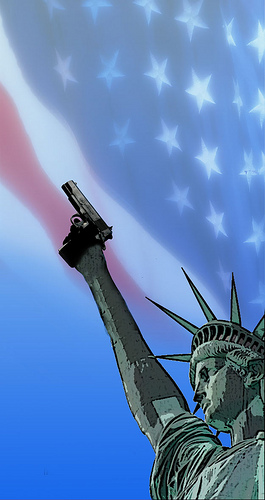
Back in 2011, the Obama administration came to blows with the Republicans on raising the debt ceiling for the US government and as part of the compromise that broke the impasse both parties agreed to point a gun to their foreheads to ensure a long-term solution was agreed on by the end of this year. This gun is the so-called fiscal cliff: a combination of draconian tax increases and spending cuts worth about 5% of GDP over a year that would kick in on January 2nd and are likely to topple America’s fragile economy back into recession. No one in their right minds would contemplate rolling out such a harsh package at this stage of the American recovery, and indeed the whole world (American politicians included) assumed the fiscal cliff would be enough to ensure a deal is passed in Washington. The question now is what kind of deal.

Initially Mr Obama had pushed for a rise in tax rates for those earning over $250,000 a year, subsequently rising that threshold to $400,000. He has also agreed to change the way Social Security benefits are indexed to inflation and called for a two-year extension of the debt ceiling. For his part John Boehner, the Republican speaker of the House of Representatives, has also made some concessions. He had conceded that tax rates could rise for those earning over $1m a year and the revenue he is prepared to see gathered over ten years now stands at $1 trillion.  However the suicidal polarisation of US politics makes any reasonable deal unpalatable to one or both of the parties.

The concession to allow the Bush-era tax cuts to expire for those earning over $1m a year came under Mr Boehner’s Plan B, which still left a fiscal tightening of nearly 3% of GDP over a year. As it happens even this largely symbolic tax rise (the Americans affected by it number about 400,000, or 0.3% of tax filers) was anathema to the fiscal hawks in the G.O.P. and so they promptly proceeded to reject it.
The odds now seem to be in Mr Obama’s favour. Whilst a grand bargain which involves a package of spending cuts and tax rises worth at least 2% of GDP to stabilise the debt level is not likely to emerge from the last-ditch negotiations going on right now, the G.O.P. has manoeuvred itself into a corner. Mr Obama’s fall-back position involves a minimalist bill that would prevent an income tax rise on the middle class and extends vital unemployment insurance for Americans looking for a job. If Republicans voted against this for whatever ideological reasons, they would essentially be voting for a tax rise on ordinary Americans. Given that recent polls have found that 53% of Americans would blame the Republicans if the country toppled over the cliff, it is a powerful incentive for them to compromise to avoid becoming the subject of public opprobrium and being eternally branded as the party of the rich as the whole country reels back into recession.

Unfortunately the deadlock is not just about economics. November’s election painted a dreary picture in terms of the polarisation of the country. The number of states that was decided marginally, i.e. by five percentage points or less, decreased from six to four, meaning that incumbents have safer seats and can ignore the needs of the country in favour of their constituents. More worryingly however is the fact that these seats may be safe from the rival party, but, especially for the Republicans, they dramatically increase the battles at the primaries. To vote for a tax rise now would be for many Republicans analogous to committing political suicide. Of course there are moderates within the G.O.P., and both their political futures and the passing of a deal on the fiscal cliff rest on them being able to form a large enough block to give them political cover. The ideological polarisation within the G.O.P. therefore matches that of the entire country, and the repercussions of such a divide are crucial not just for the fiscal cliff but for the other items on Obama’s agenda, such as climate change and gun control.


Whatever final deal emerges then, it will most probably not be a definitive one for the deficit but it will give us a clue as to the turn American politics will be taking. As ever, it’s not just the economy, stupid.

Wednesday, 26 December 2012

License to kill

From: Alan Cleaver
“A well regulated militia being necessary to the security of a free state, the right of the people to keep and bear arms shall not be infringed.” When Thomas Jefferson signed the Second Amendment which was adopted into law in 1791, he probably did not envisage these fateful words underpinning a government policy that made the massacre of twenty children possible on December 14.

The Sandy Hook carnage, which saw a twenty-year old man armed with a semi-automatic rifle with an extended magazine and two semi-automatic handguns enter an elementary school and go on a ten-minute rampage, leaving twenty children (mostly six and seven year olds) and six teachers dead, has largely receded from the headlines. President Obama made his fourth visit to a community rocked by a mass shooting, proffering heartfelt sympathy and a promise to make progress on gun control, only to return to Washington to haggle with obdurate Republicans over the impending fiscal cliff. Of course, to conflate these two issues would be wrong: the debt has to be dealt with now whilst gun control can wait, for a bit. Hopes were raised that Obama’s would not be empty promises by the combination of the sheer scale of indignation at the massacre that swept the country and the fact that Obama does not have to worry about re-election anymore. The public outrage will fade, as is only natural, but Obama’s promise to act within weeks still stands. Unfortunately, so do the seemingly insurmountable obstacles to enacting stricter gun control.

Let’s go back to Jefferson and the Second Amendment. Upon first reading, that sentence, despite its questionable grammatical integrity, does not unequivocally guarantee the right of American individuals to carry arms. In fact, what it actually says and what was upheld by the courts for over a hundred years was that state militias had a right to bear arms, not individuals. Then came the landmark District of Columbia v. Heller 2008 judgement which decided the second clause trumped the first on militias and that therefore the federal government could not ban handguns. As Jeffrey Toobin, writing on the New Yorker, helpfully points out, in the twenty-first century Justice Antonin Scalia could not enshrine the right of individuals to bear the latest military machinery, however ring-fencing handguns proved a suitable political compromise because “handguns are the most popular weapon chosen by Americans for self-defence in the home, and a complete prohibition of their use is invalid.” What this shows is that the precise meaning of the Second Amendment is not set in stone, or paper for that matter. Just because a constitution is written does not mean it cannot evolve like an unwritten one as the values of a country change. However it does mean that hawks in the National Rifle Association (N.R.A.) can cling to words written in a completely outdated context to wage a veritable political campaign. Richard Feldman, from the Independent Firearms Owners Association, said that it would be unconstitutional for the government to “come and get the guns” because the “Supreme Court has already ruled on this issue.” Except the Supreme Court has changed its mind over the decades based on the tides in public opinion, so the case is anything but closed.

So we can now move from these rather arcane constitutional debates to the guns themselves. In 2011 the total of firearm homicides in the US was 11,101. To put this figure into perspective, consider that in 2008-2009, 39 people died from crimes involving firearms in England and Wales, compared to 12,000 in the US in 2008. Even if we adjust for population, that of England and Wales is about one-sixth of America’s, leaving the number staggeringly high. More people are killed by firearms every year than the total number of US military casualties in Iraq and Afghanistan since 2001. And finally, 31 people die every day from firearm homicides. Is it really plausible to argue that the circulation of 300m guns in America has no connection whatsoever to these statistics? If it is not about the guns, but about the people, then does America really have so many more mentally deranged mass murderers than other countries? Even this muddies the waters of the debate, because mass shootings are only one type of murder adding to the firearm death toll; therefore we must ask whether Americans at large have some innate murderous proclivity that accounts for these figures. Feldman goes on to state that the problem with guns involves “clearly mentally deranged individuals [...] we have a failed mental health system now in this country, and if we don't put resources into getting at these people before they commit such horrible acts we're not going to solve this problem.” Well that clears it up. I am sure we can all agree that the reason Britain, Canada and Australia, to name but a few, have such drastically lower firearm death rates is because their mental health systems are infinitely better than America’s. One would surely have to be mentally deranged to posit a correlation between the number of guns and the number of murders.

Modern studies of criminal violence have shown that crime, of all kinds, is to some extent opportunistic. As Adam Gopnik writes on the New Yorker, “even madmen need opportunities to display their madness, and behave in different ways depending on the possibilities at hand.” That is why, on the same day that Adam Lanza unleashed his madness on defenceless children, a fellow madman in China who burst into a classroom “only” managed to sever a few ears and fingers. Had he had a gun in his hands, would he not have used it instead of his measly knife? Or perhaps Min Yongjun had been to see his therapist earlier who had successfully dissuaded him from using his semi-automatic rifle. It is one thing to argue for tightening gun controls to prevent people with mental health issues getting their hands on them given the many loopholes in existing US law; it is quite another to claim that guns are simply not the problem.
Opponents of stricter gun control seem to employ the mutual deterrence line of reasoning: if only everyone had guns, then no one would use them. Just like nuclear weapons. If only the teachers at Sandy Hook had been armed with guns themselves the massacre might have been prevented, or in any case stopped midway. Either Adam Lanza, knowing that all teachers carry guns in an elementary school, would have abandoned his crazy plans (but this undermines the argument that putting up barriers – like taking away guns - to the execution of crimes would have no deterrent effect on the mentally deranged) or a teacher would have stood up against this lone madman in some sort of heroic counterattack.

The words of Wayne LaPierre, executive vice-president of the N.R.A., at a recent press conference would be anathema in any country not at war. He said that people “driven by demons” along with a “much larger, more lethal criminal class,” were among Americans and that the only way to stop them was with guns—more specifically with “armed security in every school” and a “National Model School Shield Program” to be developed by the N.R.A. Quite aside from his derogatory depiction of the mentally ill as some sort of subversive cancer in American society, it is paradoxical to claim that the only way Americans can live peacefully is by arming them to the teeth. And once we have armed all the teachers to enable them to protect their class from madmen with murderous inclinations, who is going to ensure that the teachers do not turn on their own students? Must we arm the children too? No, of course not, we should simply focus on improving the method for selecting teachers and ensuring that people with mental health problems never make it to the classroom.

At the end of the day, however, the most shocking fact is that a majority of Americans support the status quo. Even Beth Nimmo, the mother of a Columbine shooting victim, does not support a ban on all guns and thinks that it “is getting pretty grim that anybody can walk on a campus and there is no protection for those who are in the school themselves.” Never mind working towards a solution that would render such protection unnecessary in the first place. A ban on guns would only be the first step in America; the harder task would be removing the 300m guns already in circulation, but that is no reason for inaction. In the words of Bertolt Brecht, “unhappy is the land that needs a hero.”

Wednesday, 31 October 2012

Sandy enters the political fray

From: david_shankbone

Ever heard Harold Wilson's saying that "a week is a long time in politics"? Back in September we were all clamouring over Mitt Romney's lame-brained handling of the attack on the American embassy in Libya which cost the Ambassador his life and how it would affect his campaign. Today, in the aftermath of Hurricane Sandy's destructive battering of America's east coast, this incident is all but forgotten. In fact, it had probably already been buried in voters' minds long before Hurricane Sandy decided to take the reins of the presidential campaign.


Faced with such devastation, both contenders have put a halt to their respective campaigns, with President Obama cancelling campaign events to stay at the White House and Mitt Romney converting an Ohio rally into a storm relief event. However, with less than a week left until election day, politics cannot be swept away as it was with the Libyan incident. Granted, as President, Obama has a firm duty to manage the disaster in the best way possible regardless of the impending election, but that does not mean that the political spotlights will not be blaring as he does his job. One cannot naively presume that Obama simply feels no added pressure from the election to nail the emergency response. He may not want to appear as if he is overtly politicising the disaster, but he is most certainly aware that a good show of leadership, sympathy and competence is fundamentally political, and thus inextricably forms part of his campaign. As Mark Mardell from the BBC points out, Hurricane Sandy "puts the spotlight on President Obama as a leader in a time of crisis – both in terms of deeds and words." In effect, appearing to put politics aside is a fundamentally strategic political act; it is about being a president, and thus a political leader of a country. As such, failure to rise to the occasion will have political costs but it also presents a great opportunity to make a last stand in a neck-and-neck race. In fact, according to The Economist/YouGov poll 36% of respondents would describe Obama as “strong” and Romney follows close behind with 34%. So it is all the more important for Obama to rise up to the challenge, especially since the percentage of Americans who view him as a strong and decisive leader has steadily decreased since 2009, when it stood at 73% according to a Gallup poll.Sure, Obama did say that “I am not worried at this point on the impact on the election. I’m worried about the impact on families and our first responders. The election will take care of itself next week.” Nonetheless, it cannot be denied that natural disasters have political repercussions, particularly for presidents who have to take the lead.


For Mitt Romney there is less to be gained (and lost) as the media will not be interested in any speech he makes and he is not faced with one of the greatest challenges of his career. In fact, Hurricane Sandy has pushed him into the sidelines and putting politics aside is a less "political" act for him than it is for Obama. Whereas Romney's show of good taste by turning his rally into a relief event is only the minimum to be expected from him, it will not really score him any political points. Because of this he will resume campaigning today. Obama, on the other hand, will not resume his campaign but the fundamental difference is that he does not need to. Every decision taken with regards to the disaster relief will feed into his campaign whether he likes it or not. His last act before the election will simply be to do his job.

Monday, 15 October 2012

The EU must live up to its vision


It has been a while since the EU hit the front page on a happy note. Yet the decision to award the Nobel Peace Prize to the EU was as unexpected as it was puzzling. In fact, the decision follows the trend started when the committee awarded it to US President Barack Obama whilst his country was embroiled in two wars, but at least the US is not mired in an existential crisis. The beleaguered EU was praised for contributing to the advancement of peace and reconciliation, democracy and human rights in Europe over six decades. The EU, said the Nobel committee, has helped transform Europe “from a continent of war to a continent of peace.”

The EU must be given its due. War between France and Germany is now unthinkable, and the EU became a model to aspire to for Eastern European countries emerging from their Communist regimes. Moreover, it helped countries such as Spain, Portugal and Greece to make the transition from dictatorship to democracy. So far so good.

Since the eruption of the euro crisis over two years ago, however, the EU has failed time and time again to demonstrate the leadership and visionary decision-making that it ought to have to be worthy of this prize. The crisis engulfing the eurozone threatens not just the 17 countries within it, but the whole European integration project as has been reiterated by none other than the German Chancellor Angela Merkel. But let us leave aside the economics and focus on the politics for an instant.

 Instead of seeking to promote a sense of unity and reignite that spark that will make our eyes glaze over with delight for an “ever close union”, the discourse in Europe is smeered by acrimonious references to fiscal sinners and saints. Anti-Germans aver that Germany has reaped all the benefits of the euro at the expense of its southern neighbours and is refusing to pay its share of the deal by stymieing efforts at creating a banking union or recapitalising troubled banks. The creditors retort that they successfully implemented tough structural reforms to improve their competitiveness whilst southerners squandered their cheap money left, right and centre. Not only, but they are also the ones with the deep pockets for the bailout funds, so unless these feckless southerners want to see their lifeline cut they ought to stop yakking on about Germany needing to boost its domestic demand and get on with some reforms themselves. This effect of this damaging talk should not be underestimated, especially considering that Europe desperately needs to garner some popular support in order to progress with integration where it is needed most. Given that austerity measures are presented as the price for continued eurozone membership, short-sighted European leaders are saving face whilst not only stalling the integration process but unravelling it.

 Moreover, the EU’s appalling handling of the crisis has abetted the rise of populist and extremist parties such as the Greece’s neo-Nazi Golden Dawn party which feeds on the hated troika of technocrats making repeated visits to ensure the shattered country is strangling its economy just a little more. Italian newspaper Il Giornale ran a front page that denounced a German “Fourth Reich” whilst Greek protesters greeted Angela Merkel in Nazi uniforms when she visited Athens.

Centrifugal forces have also strengthened in the EU as a result of the crisis. Britain has slowly but steadily been distancing itself from the union and populist parties everywhere are jumping on the euroscepticism bandwagon to capitalise on voter discontent and waggle their accusatory fingers at the EU. The economic pain wrought by relentless austerity measures, which are doing nothing to stop Greek GDP plunging by a whopping 5% a year, is accompanied by increasing social tensions as citizens take to the streets in an often violent fashion. In Spain the anti-austerity protests have revived secessionist feelings in Catalonia which have done nothing to assuage markets on Spain’s precarious financial position. Catalonia, in fact, accounts for a fifth of the country’s economy. With unemployment in both Greece and Spain over 25%, the potential for social unrest is high.

This is not the track record of an organisation that continues to advance peace and democracy. The awarding of the Nobel Peace Prize is therefore a boon which European leaders have rightly grabbed on to (admittedly with a degree of desperation) but it is a stark reminder of the gargantuan task they have ahead of them. National politicians need to stop belittling the EU whenever it suits their political strategies and work harder to present the austerity measures not only as a steep price for continued membership of the eurozone, but as part of a more long-term process of rectifying a country’s finances which needed to be done anyways (that is, if national politicians want to continue with such draconian austerity measures in the face of their lukewarm success). If Angela Merkel decides to show the requisite leadership for battling the flames engulfing the continent and actually act on the “inspiration” the Nobel Peace Prize gave her to press ahead with closer integration, then she, and others, will need to work collectively to close the democratic deficit of the EU when this risks fuelling existing divisions. At this stage of rising popular resentment with the EU and dangerous nationalism, further integration is unthinkable if the EU’s legitimacy is not enhanced first. The awarding of the Nobel Peace Prize was merely the starting gun.

Tuesday, 25 September 2012

Slipping, slipping...


From: DonkeyHotey

It seems that the old idiom “it never rains but it pours” has never been truer for Mitt Romney than it was last week. No sooner had his half-baked attempt to score political points from the assassination of the United States’ ambassador to Libya spectacularly backfired than some grainy footage in which he disparaged almost half of the American electorate surfaced. To make matters even worse, his campaign’s promise to unveil a new strategy with more details on Romney’s plans (they had been blatantly absent hitherto) was not to be, as his gaffes left him standing awkwardly in the media limelight.

Romney was caught on film at a fund-raising dinner in Florida in May saying that the 47% of Americans who do not pay income tax “believe that they are the victims” and could never be persuaded to “take personal responsibility and care for their lives.” As the cherry on top he added that they “believe they are entitled to health care, to food, to housing, to you name it...and they will vote for this president no matter what.” In a sense, it is true that he has fewer voters to convince given the increasingly polarised electorate. As Republican Don Fierce explained, “The number of people we’re trying to win over is very small...that’s what’s different from 1980 or other campaigns in the past — there’s such a small number that are there to move.” Notwithstanding polarised politics, writing off half the electorate in a rather supercilious manner as ineffectual spongers is probably not the best way to go about convincing that small, undecided chunk.

As The Economist notes, the frozen party loyalties in American presidential elections do not mean that elite actors cannot influence the fringe sections of the partisan electorate, and this year it looks like capturing just those swing voters will be key to winning. Obama will benefit from a steady support base of Hispanics, African-Americans, and university-educated women in addition to changing demographics. What were previously traditional swing states, such as Nevada, Colorado, Virginia and North Carolina, have now become Democrat strongholds thanks to the rising Hispanic share of the vote. 

Whilst gaffes are a staple feature of campaigns and a rite of passage for most politicians in the spotlight, Romney risks alienating part of his more moderate elite by pandering to the strident, yet stale, ideas of his conservative base. Having tacked back to the centre of the political spectrum after the primary he has dispelled his image as one of the more moderate Republicans only to reveal that he is clumsily out of touch with the electorate as well as fickle when it comes to his positions on important issues. He seems to have gambled everything on the economy, which is indeed the overriding issue of November’s election, but has failed to capitalise on the general disenchantment by offering a specific plan for revitalising it and creating those elusive jobs. Moreover, his lack of a plan seems to signal that he has staked everything on the economic situation being so dismal that it irreversibly tarnishes Obama’s record so as to make his re-election inconceivable. It is quite a hazard to rely on external events, rather than one’s own capacities, to attain leadership of a country.

It is also hard to see how Romney will be able to surmount the high level of public admiration for Obama which is impervious to depressing economic data and stems rather from his historic significance as the first black president. The high degree of public sympathy for Obama arising from those voters who do believe he was handed an exceptionally bad hand of cards from his predecessor George W. Bush will also play in his favour, unless, say, Romney is banking on the United States being hit by an economic cataclysm on the scale of Lehman Brothers between now and November.

Romney’s vacillating positions highlight his lack of an overarching and most importantly, vaguely inspiring message. He churns out the standard Republican spiel on the economy and foreign policy (actually he’s said precious little in this regard) but has failed to translate it into a clear, coherent and specific message about how he is going to turn the status quo around. Even if we were to overlook the absence of a vision, we could not find Romney compensating for this with his personality. In fact, he just comes across as being a bit awkward, flailing about like a goldfish thrown out of its bowl. He does not have Obama’s penchant for rhetoric and has pretty much handed his opponents a joker card with his background, which was always going to be a magnet for flak in tough economic times. This is not to say that his career at Bain Capital is worthy of condemnation per se, but rather that any other candidate would seek to mitigate its potentially negative legacy and turn it around to highlight the leadership, business know-how and management qualities that Romney demonstrated there. It goes without saying that telling a bunch of fellow millionaires that almost half the American electorate is a hopeless case is, to put it lightly, not wise.

The presidential race is still not set in stone, and given how fast things have turned in the recent weeks it is perfectly possible for them to turn back the other way. It would be rash to write off Mitt Romney just yet. But if he keeps fudging along as he has until now he will quickly have finished digging his own electoral grave.